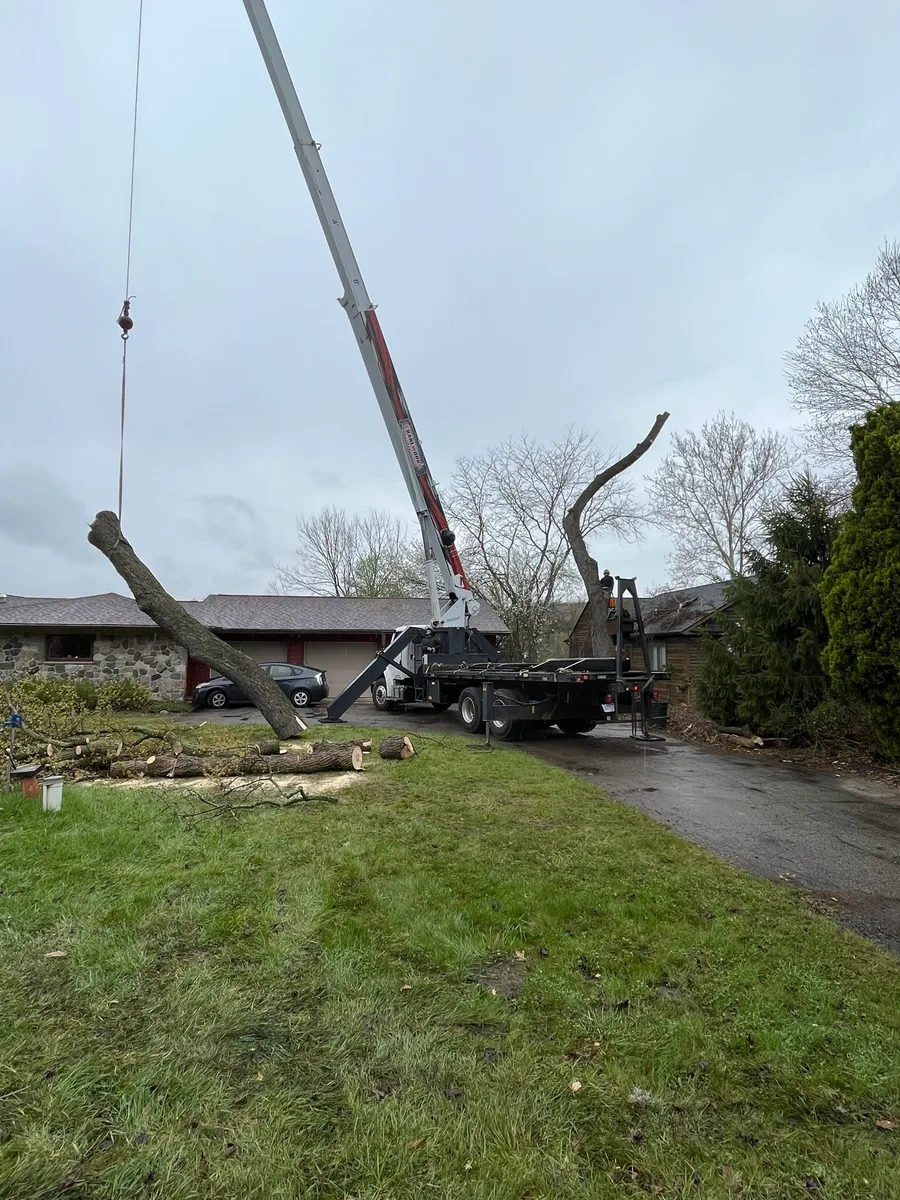
Crane-Assisted Removal in Ann Arbor, MI — The jobs other crews walk away from.
Crane-assisted tree removal in Ann Arbor and Southeast Michigan. Heavy lifts over rooflines, power lines, and tight lots. Licensed and insured. Free estimates.
Crane-assisted tree removal uses a crane to lift sections of a tree clear of structures, power lines, and other obstacles that make conventional removal too risky. It’s the solution for the jobs that require precision beyond what climbing and rigging alone can deliver.
Foundations Tree Experts provides crane-assisted removal across Ann Arbor and Southeast Michigan for trees that other crews walk away from — over rooflines, between buildings, adjacent to power lines, and in lots too tight for bucket trucks.
When is crane removal the right choice?
Not every tree needs a crane. Conventional climbing and rigging handles the majority of removals safely and efficiently. A crane becomes the right tool when:
- The tree overhangs a structure and sections can’t be dropped without risking roof, siding, or deck damage
- Power lines are directly adjacent and there’s no room to swing rigged sections clear
- The tree is dead or structurally compromised and too unsafe for a climber to ascend
- There’s no room for a bucket truck — narrow side yards, fenced backyards, or dense landscaping
- The tree is exceptionally large — where the weight of individual sections exceeds safe rigging limits
- Speed is critical — crane removal is often faster than piece-by-piece rigging for complex trees
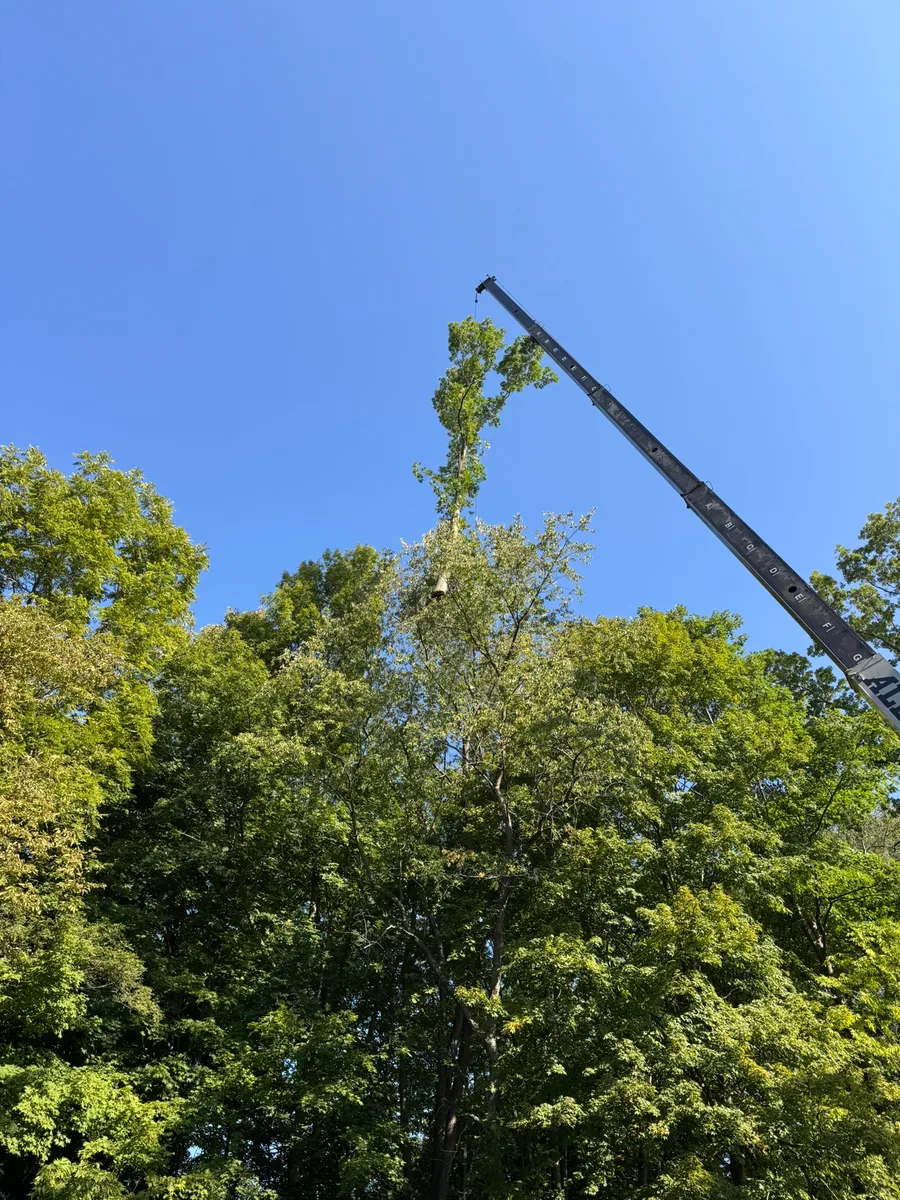
How does crane-assisted removal work?
Crane removal is a coordinated operation between the climber, crane operator, and ground crew:
-
The crane is positioned and stabilized on firm ground — typically a driveway, street, or cleared area. Outriggers extend to distribute the crane’s weight and provide stability.
-
Our climber ascends the tree and begins attaching rigging (straps and cables) to the top section. Each section is planned in advance — size, weight, and cut sequence are determined during the site assessment.
-
The crane takes the load. Before the cut is made, the crane operator tensions the line so the section’s weight is supported. The climber makes the cut, and the crane lifts the section straight up — clearing the roofline, power lines, or whatever obstacle is below.
-
The section is swung to a clear landing zone where the ground crew detaches it for processing. The climber descends to the next section and repeats the process.
-
Once the trunk is at a manageable height, the remaining base can be conventionally felled or cut in sections at ground level.
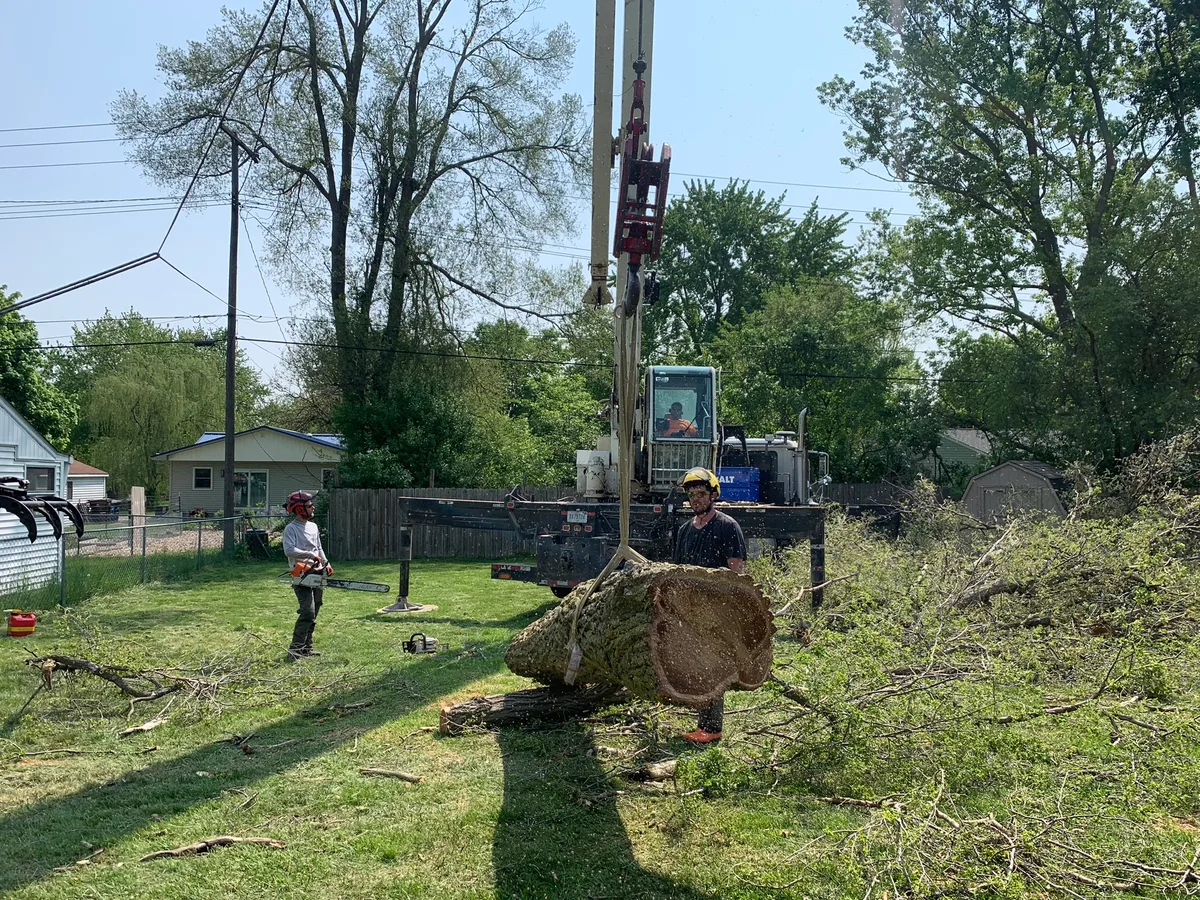
What sets crane removal apart from standard removal?
| Factor | Standard Removal | Crane-Assisted |
|---|---|---|
| Risk to structures | Moderate — relies on rigging and drop zones | Low — sections lifted clear of obstacles |
| Climber safety | Climber works in the tree for hours | Climber makes cuts; crane handles the weight |
| Time on-site | Varies by complexity | Varies — often faster for complex trees |
| Equipment access | Needs only ground crew access | Needs crane staging area (driveway or street) |
| Best for | Open lots, trees away from structures | Trees over/near structures, dead trees, tight lots |
Ready for a free crane-assisted removal estimate?
We'll walk the property, assess the job, and give you a firm written quote — no pressure, no obligation.
How crane-assisted removal works
Site assessment and planning
Our crew lead evaluates the tree, access points, overhead obstructions, and staging areas. We determine the crane size needed and develop a lift plan for each section.
Crane setup and rigging
The crane is positioned and stabilized. Our climber ascends the tree and attaches rigging to each section according to the lift plan. Every pick is calculated for weight and swing path.
Controlled lifts
Sections are cut and lifted clear of structures, power lines, and landscaping. The crane operator and climber work in constant communication to control each piece from cut to ground.
Processing and cleanup
Once all sections are on the ground, the crew processes wood, chips brush, and cleans the site. The crane is demobilized and the property is left clean.
Crane-Assisted Removal FAQ
When is a crane needed for tree removal?
A crane is used when a tree can't be safely dropped or sectioned in place — typically when the tree is too close to a house, garage, or power lines for conventional rigging, when there's no room for a bucket truck, or when the tree is dead and too unstable to climb safely.
Is crane removal safe for my property?
Crane removal is actually the safest option for trees near structures. Instead of dropping sections and hoping they clear the roofline, the crane lifts each piece straight up and swings it to a clear landing zone. There's less risk of damage to the property than conventional methods in tight situations.
How much room do you need for the crane?
The crane needs a firm, level area for setup — typically a driveway, street, or cleared section of yard. We assess access during the site visit and plan staging accordingly. In some cases, we can work from the street with traffic control.
How long does a crane removal take?
Timeline depends on the tree and site complexity. We'll provide a time estimate during your free on-site assessment.
Do you do crane work in emergencies?
Yes — when a storm brings down a large tree onto a structure, crane removal is often the fastest and safest way to get it off. We coordinate crane mobilization for emergency situations as quickly as conditions allow.